The Art of Worldly Wisdom, Baltasar Gracián
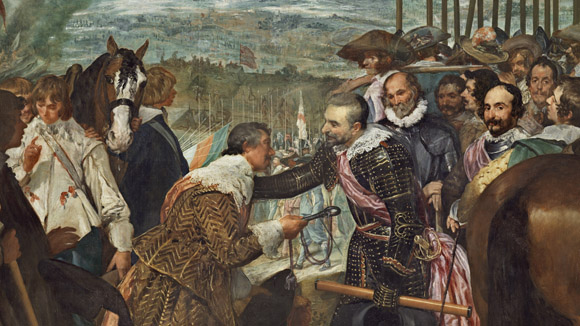
Velázquez, The Surrender of Breda
Wait. It's a sign of a noble heart dowered with patience, never to be in a hurry, never to be in a passion. First be master over yourself if you would be master over others. You must pass through the circumference of time before arriving at the centre of opportunity. A wise reserve seasons the aims and matures the means.
Now for a tasty slice of seasoned and matured jamón in our triple-decker Montaigne sandwich: Baltasar Gracián's Oráculo Manual y Arte de Prudencia. Gracián (1601–1658) was a Jesuit priest, philosopher, and one of the brightest lights of Spanish literature. Despite the efforts of church authorities to get him to stop publishing, seven works escaped his sharp and subtle mind, works that long after his death would earn extravagant praise from figures as varied as Schopenhauer, Nietzsche, and Elon Musk (three sometime atheists that nonetheless found much to admire in this Catholic clergyman's thinking).
The Art of Worldy Wisdom, his most popular and accessible book, is a collection of 300 humane-but-realistic aphorisms with brief commentary. Fans of La Rochefoucauld will detect the considerable influence that Gracián had on him with this book, published less than two decades prior to his Maximes (a favorite of O.S.S.I. in the past). But if that doesn't sell you on the Oráculo Manual, then try this:
Pride yourself on the fact that if gallantry, generosity, and fidelity disappeared from the world, they could be found in you.
Now what could better express the ethos of our club than that?
I will be reading Christopher Maurer's best-selling 1992 translation, but others are available. Please note that the title can be rendered differently; Penguin, for instance, has it as The Pocket Oracle and Art of Prudence.
We will meet at 7 PM, as always, on Monday, September 28, at the usual place.
 2026
2026 Subscribe with RSS
 Flickr
 Twitter
 Google +
 LinkedIn